In 2026, choosing a Robotic Motor means matching motion to the real task, not simply selecting the highest torque rating. A compact collaborative arm, a mobile platform, and a pick-and-place unit place different demands on their drives. Load, speed, acceleration, duty cycle, heat, and available space all matter. So do the controller, encoder, gearbox, and power supply. A motor that looks ideal on a catalogue page may run hot after repeated starts or struggle when a payload shifts.
Robotics pioneer Rodney Brooks wrote, “The world is its own best model.” That principle is useful here: real operating conditions reveal what a specification sheet cannot. Measure the load at the joint or wheel, estimate peak and continuous torque, and check the motor’s thermal limits. Then compare brushless, brushed, and stepper options against control needs, maintenance, noise, and cost. Numbers can mislead. A generous peak rating is not a substitute for continuous performance.
This guide explains how to define requirements, compare motor types, evaluate torque and speed, and check compatibility with the rest of the system. It also covers feedback, thermal management, reliability, and supplier documentation. Small details matter. Cable routing and mounting space can change a design late in development. There is no perfect motor for every robot, and early estimates are sometimes wrong. Revisit them with test data before committing to production.
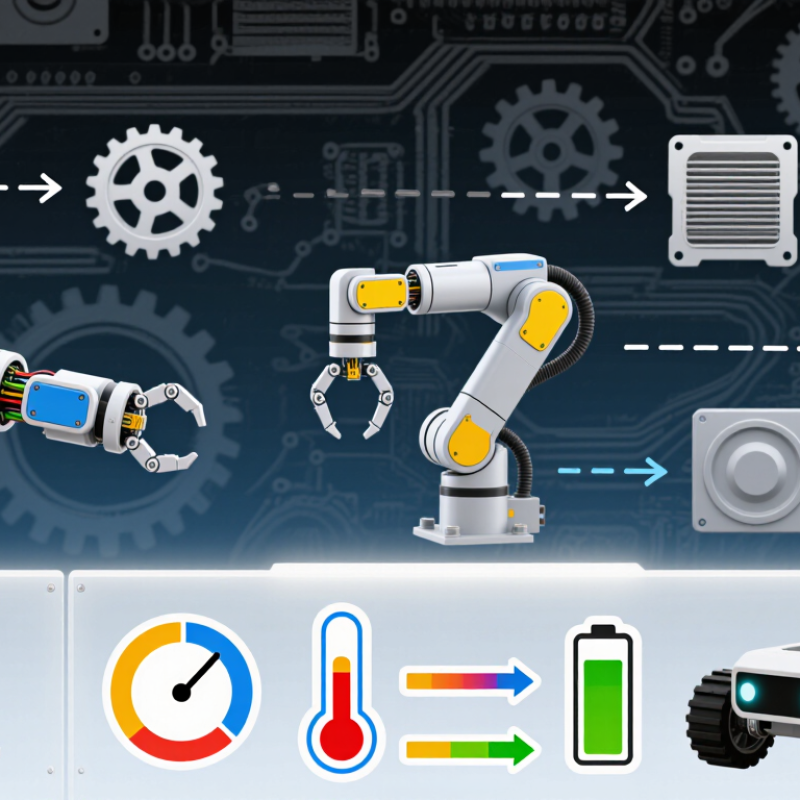
Start with the moving load, not the motor catalog. Include the gripper, payload, cables, and any fixture that travels with the axis. A 2 kg part can demand much more torque when mounted far from a pivot. Estimate inertia, friction, gravity, and acceleration; each changes the motor’s workload. Describe the toughest realistic motion, such as lifting a part, reversing direction, or stopping at the end of a stroke. Be specific. A small overlooked bracket can affect the result.
Describe duty cycle as a timeline: seconds moving, seconds holding, and pauses per hour. Repeated short bursts may heat a motor more than one smooth demonstration suggests. Compare calculated RMS torque with the continuous rating, and peak torque with its permitted duration. Then map torque against speed across the whole move, including acceleration and braking. The operating point must remain within motor and drive limits, not merely reach the target speed. Leave margin for changing payloads and friction, but question a margin that seems excessive; added motor inertia can dull response. No estimate is exact. Recheck assumptions after measuring several real cycles.
A robot’s motor choice begins with the motion, not the catalog. A pick-and-place arm needs fast starts, precise stops, and controlled torque. A conveyor may need steady rotation for hours. The International Federation of Robotics reported 4.28 million industrial robots operating worldwide in 2023 in World Robotics 2024. That scale makes correct motor sizing important, but the report does not prescribe one motor type for every axis.
Choose a servo when the axis needs closed-loop position control, rapid acceleration, or changing loads. It uses encoder feedback to correct errors, but adds drive and tuning complexity. A BLDC motor suits compact, efficient motion with a wide speed range, especially when paired with suitable feedback. A stepper can position small loads simply and economically; however, missed steps become possible if torque demand exceeds its margin. Not glamorous. Still critical.
For a fan, pump, or long-running conveyor, an induction motor can be a durable, cost-effective fit, particularly when precise positioning is unnecessary. Check the full duty cycle: payload, speed, acceleration, thermal limits, gearbox losses, and stopping frequency. Then compare motor curves with the actual load, not just peak torque. I would still leave extra margin for friction and future payload changes; those estimates are easy to underestimate. The best choice depends on the axis, drive, and operating profile—not the motor label alone.
Choosing a robotic motor in 2026 starts with the positioning test, not the encoder’s headline count. ISO 9283:1998 defines methods for evaluating industrial robot performance, including pose accuracy, pose repeatability, and path characteristics. Encoder resolution helps describe the smallest measured motor-shaft increment; it does not prove tool-center-point accuracy. A 20-bit encoder may look impressive, yet gearbox backlash, joint compliance, and thermal drift can dominate the result. The arithmetic is neat. The machine is not.
Translate the required TCP measurement interval into motor-shaft counts using the transmission ratio, then check the full error budget against the acceptance tolerance. For example, a 0.1 mm test interval at the tool may demand far finer shaft feedback after gearing, but finer counts alone cannot remove mechanical error. Validate the assembled robot with the measurement setup and operating conditions specified for the test. ISO 9283 is the test-method reference; it does not prescribe a universal encoder resolution. The International Federation of Robotics’ World Robotics 2024 report counted 4,281,585 industrial robots operating worldwide in 2023, underscoring the scale of performance-critical automation. That figure is industry context, not a motor-sizing rule. One easy-to-miss detail: report the encoder’s effective counts per revolution, since decoding conventions can change the stated count.
Under IEC 60034-30-1, compare efficiency classes only after confirming motor type, rated output, pole count, and supply frequency. The standard classifies eligible line-operated AC motors as IE1 (Standard), IE2 (High), IE3 (Premium), or IE4 (Super Premium); thresholds vary by motor rating and configuration. Many robotic axes use converter-fed servo motors, so verify that the standard applies. If it does not, request motor-and-drive loss data across the speeds and loads your robot actually uses.
The IEA’s 2011 report, Energy-Efficiency Policy Opportunities for Electric Motor-Driven Systems, estimated that motor-driven systems consume about 46% of global electricity. That is not a robot-specific figure, but it shows why motor losses matter. For a pick-and-place arm, log current, torque, speed, and idle time over a representative shift. A motor efficient at rated load may perform differently during repeated acceleration and light-load pauses. Small gains matter. Compare efficiency at the intended duty point, then check winding temperature, peak torque, and regenerative-braking behavior. I would not choose the highest IE class blindly: standardized ratings cannot replace measurements across a real, often messy, operating cycle.
How to Choose a Robotic Motor in 2026?
Validate Peak Torque, RMS Torque, Thermal Limits, and Drive Compatibility
A motor’s peak torque rating can look impressive on a specification sheet. Check how long the motor can provide that torque, and how often the load demands it. A brief lift may need high peak torque, while repeated moves depend more on RMS torque. Calculate RMS torque from the actual motion profile, including acceleration, deceleration, pauses, and payload changes. Numbers can deceive.
Thermal limits deserve equal attention. Compare the motor’s stated limits with its mounting, ambient temperature, and cooling conditions. A motor tested on an open bench may run hotter inside a compact arm. Log winding or case temperature during a representative cycle, and repeat the test at the expected workload. RMS estimates can miss sharp torque spikes; I have seen that detail complicate otherwise tidy calculations.
Confirm drive compatibility before choosing a motor. Match supply voltage and continuous and peak current, then check encoder type, feedback resolution, and communication interface. Also verify whether the drive can handle regenerative energy during fast deceleration. Test the complete motor-drive combination under load, not just at idle. Real motion can expose issues that a spreadsheet will not.
Include the payload, gripper, cables, and fixtures that travel with the axis. A small bracket can matter.
Estimate inertia, friction, gravity, and acceleration. Check the hardest realistic move, such as lifting, reversing, or stopping. A part mounted far from a pivot can demand more torque.
Record seconds moving, holding, and pausing per hour. Repeated short bursts may heat a motor more than one smooth demonstration. Small details matter.
Peak torque must stay within its permitted duration. RMS torque should be compared with the continuous rating across the actual motion profile. Numbers can deceive.
Convert the required tool-position measurement interval into motor-shaft counts using the transmission ratio. Check effective counts per revolution, since decoding methods can change the stated count.
No. Gearbox backlash, joint flex, and thermal drift can dominate. The arithmetic is neat. The machine is not.
Consider mounting, ambient temperature, and cooling. Log winding or case temperature during representative cycles, then repeat at the expected workload. Bench tests mislead.
Match supply voltage, continuous and peak current, encoder feedback, and communication interface. Check regenerative energy during fast braking, then test the loaded system. I may have trusted calculations too much.
Choosing a Robotic Motor in 2026 starts with understanding the robot’s workload. Define the load, operating cycle, and required torque–speed profile, including both routine motion and short periods of high demand. Then select a motor type that suits the task: servo motors for precise controlled movement, BLDC motors for efficient dynamic operation, stepper motors for suitable incremental positioning, or induction motors for appropriate continuous-duty applications.
Check that the encoder provides enough resolution for the required positioning tests, including considerations relevant to ISO 9283. Compare efficiency classes and ratings under IEC 60034-30-1, and verify that the motor and drive can work together. Before finalizing a choice, assess peak torque, RMS torque, thermal limits, and expected operating conditions. This systematic process helps balance accuracy, performance, efficiency, and reliability without oversizing the motor.

DyneticPro Motor